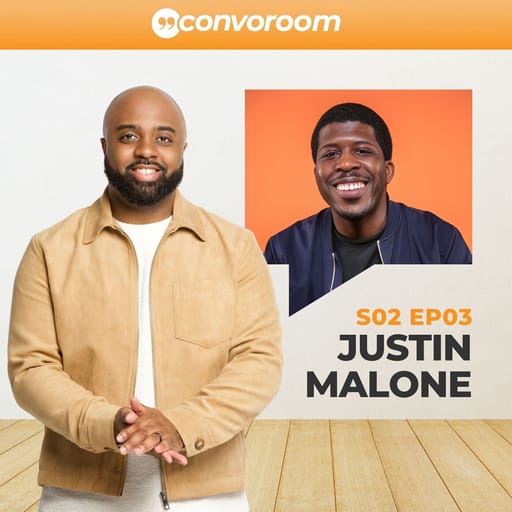
Transcript 0:00 [fire whooshing] What's up, family? We got Justin Malone in the Convo Room today. I'm so excited. 0:09 I met Justin on LinkedIn, and he's killing it in the content game, and I'm super excited to have him on because he's going to help us connect the dots between building your personal brand and creating opportunities. 0:22 So without further ado, Justin, welcome to the Convo Room podcast. Hey, thanks for having me, Mark. I'm super excited to be here, super excited to impart some wisdom. 0:34 Hopefully, the people who are joining today are able to just take one nugget, at least one nugget from this conversation. Um, I'm, I'm a firm believer that you don't... 0:44 Like, of course, like, try to get as much information and knowledge as possible, but I'm more so about application. If you could just take one nugget, apply it, I'm happy. Nice. So let's just get started. W- how did you 0:59 get passionate about building your own personal brand? Like, what was... what's the origin story of you? It's because let me just say, you are, you play no games on LinkedIn. Like, you, you're showing up regularly. 1:12 I think, uh, I saw you posting today about how you've been posting for years. Like, talk to us. How did you get into this? I feel like it found me. Um, I'm a firm believer of, um, really understanding your identity. 1:25 Um, once you, once, once you know who you are, then you can start to think through what's my vision? What's my purpose in life? So just growing up, I grew up in a single-parent household. 1:36 Um, wasn't too many men, um, around, around me growing up. I felt like the only place I could really see sort of positive influences, um, positive portrayals of Black men was primarily in media. 1:51 I know there's a lot of, you know, stereotypical portrayals of Black men there as well, but I also could see some positive, um, role models in media. 2:00 Although I may not know them personally, but it just helped me see that, like, there's more to life than what I saw in my neighborhood. So I've always just been fascinated with media. 2:11 And then, um, I'm a millennial, 33 years old, so I'm a part, I'm a part of that unique age where we used to play outside, play the video game, and then we made that transition to social media with MySpace and Facebook, things, things of, like social media platforms like that. 2:29 So I've always just kind of gravitated towards those. 2:34 Um, creating content, I made a, I made a, a 60-minute video in eighth grade, um, of just funny clips, of like funny moments throughout, um, middle school and put it into a movie. 2:48 Um, burnt, burnt it onto some DVDs, passed it to all my classmates in eighth grade. 2:54 I've always just kind of played around with content, and now that we're at this point where w- with social media, it can be leveraged as a marketing tool, I was just like, "You know what? 3:07 I've already been playing on social media basically half of my life anyways since a teenager. 3:12 I might as well keep doing it, creating content, and leveraging it as an opportunity to push the culture forward through, uh, media and stories." I believe that everyone has a story and, and stories have power. Yeah. 3:25 So, um, yeah, that's kind of, kind of how I got started. Um, and then- Mm-hmm... eventually I ended up on LinkedIn [chuckles] creating content. Yeah. So describe to people what is it that you do? 3:36 'Cause one, you work a corporate nine-to-five from what I understand, and then you've got your content consultancy on the side. 3:45 W- for people who are like, "Justin, okay, yeah, you create content," but like, w- what do you do? Like how do you describe that to people? [laughs] Um, the way I describe myself is, um, 3:55 some people say they are left-brained, some, some people say they are, they are right-brained, right? So for me, I actually feel like I'm right in the center. Um, I have a big passion around business. 4:08 Um, I went to school and studied entrepreneurship. 4:11 I was in business programs in, in high school as well, so I've always have had a knack for business, but talking about content creation and everything, I've always have had a knack for creating things too. 4:25 So why am I talking about that? Why am I mentioning that? What does that have to do with my, my consultancy? So I sit in the middle. I help people in the creator economy. So from a, um, 4:37 entrepreneur standpoint, I help entrepreneurs stop hiding behind their companies and help them create a personal brand and build that personal brand to drive more attention and awareness to their business 'cause people buy from people, they don't buy from brands. 4:55 And then on the other side of the house, I help content creators get out of the mindset of, "Let me just solely create content," and help them think about how can I turn the content and the influence that I have into an actual business? 5:10 Love brand deals. I think those things are great. However, solely relying on those, I don't know. You, you, you want some more, you want more stability in, in how much money you're bringing in month over month. 5:24 So that's why I think creators should also become creatorpreneurs, um- Mm-hmm... and build businesses on top of their, um, influence on social media. So I help them. 5:35 What experiences informed the way you approach being a creatorpreneur versus just being a creator? Because I feel like, yeah, you can say, "Okay, well, I want more money," 5:48 or, "I want more consistent revenue, uh, month over month," but I, I'm sure a lot of people [chuckles] want that, right? 5:57 But w- what was it that was the driving force that made it, made you realize, "Hey, that's not just a nice to have. 6:05 That's a need to have for how I'm building my creator business"?It's a need to have because at the end of the day, social media is rented property. Your email list is what-- is, is like a mortgage, it's like a house. 6:19 Like, you own it. Mm-hmm. So you want to get people off social media and actually own that relationship. And like literally, TikTok has changed ownership. 6:33 People are complaining about the algorithm, and it's seeming like no one's seeing their content anymore. 6:41 I think it was about two or three days where everybody in the United States we-weren't getting any views on their content. Mm-hmm. If you have an email list 6:51 and you were planning to launch a new program, service, whatever that day, you could still reach your email list. 7:00 But if you were launching that same day solely leveraging social media, you didn't get any sales because nobody saw your content. Mm-hmm. That's why literally- Yeah... 7:11 having ownership, having autonomy, having real control, that's where it came from. Mm. And do you feel like for people who, um... 7:23 'cause I, I feel like I might even be at the space where I'm transitioning from just testing when it comes to content and actually just really being- getting serious about like being structured. 7:37 Like, I mean, it, it's down to a science. Like, even like doing the second season of this, I'm like, "Okay, you know what? We're, we're getting them on the calendar. We're reaching out." 7:46 And now that you, you know, you got your podcast lined up, uh, you might think, "Oh, well, I don't have anything to sell," or, you know, w-what, what commerce am I doing? Like, talk to people who feel... 7:59 and now I'm saying that, you know, kind of flippantly, although in my mind I-I'm always working with somewhat of a master plan. But for the people who might be sitting out there like, "Okay, I work a corporate job. 8:11 Who in the world, uh, is going to listen to me over somebody who's got, you know, thousands of followers, hundreds of thousands of followers? Um, w-who am I to create a product, or who am I to sell anything online? 8:26 And also, I don't wanna be cringe. I don't wanna be salesy. How in the world do I start?" Honestly, divorce yourself from that mindset. You have to have a whole paradigm shift. 8:39 Like when you're saying, you're saying Mark who, for example. Like, let's, let's just use you, like, for an example here, right? If you're saying, "I'm Mark, I'm just starting all this," someone may ask, "Who's Mark?" 8:54 And then someone else could just say, like years ago, people were like, "Who's Gary Vee?" Right. "Who's Myron Golden?" Mm-hmm. Like, who are these people? What I'm saying is everyone starts at zero. 9:09 You're starting at zero, and what's the, the best part of starting at zero? You get to experiment because hardly anyone sees you anyways. Have fun with it. Figure out what works, figure out what doesn't work. 9:24 Don't, don't get so tied to what the result is. Really get in the dirt. Have fun with it. I feel like so many people, they're just like, they're so focused on the end result. They're focused on the money. 9:40 Focus on who you are as a person. What is your identity? What is your vision? What is your purpose? How can you align yourself to that? If you are an adult, what did you enjoy doing as a kid? 9:53 If you don't wanna take it from a passion angle and you wanna take it more so from a practical skill set, um, angle, what are you doing in your job right now? What do you have experience in? Can you talk about that? 10:06 Oh, I'm early in my career. How about you talk about the things that you're learning on your journey? People are more attracted to transformation than perfection. That's good. 10:18 People are more attracted to transformation than perfection, which I had a conversation earlier. Um, this was with Sean Jones. He's an influencer. Sean Jones Jr. let me be specific, and he, um, 10:32 he was talking about how he committed to doing the signature series. Mm. And I think, you know, we see this a lot on Instagram, uh, TikTok with especially short form content creators. Um, but I think it is so important. 10:47 I think the signature series is not just the idea of like anchoring your content. I really feel like it also is a way for the creator to get honest with themselves about a transformation that they want to document. 11:03 And I think that is the... it's, it's almost like the cheat code right now for people who really wanna like, get started in content. Um, and if you had to 11:15 give advice or like a, a format for people to just pursue as, "Hey, look, if, if, if you don't know what to do, I want you to sit in front of your computer, repeat this, and complete it." 11:30 Uh, like what type of content, what type of, uh, prompt would you give them to get started in telling their story? Honestly, I would tell them, "Okay," it would be... 11:42 I'd, I would start with the first thing I would do, like the first step, and then what I would do following. So the first step I would do is, um, 11:52 once I figure out if I'm more of a written audio or audio visual person, so video, 11:59 um, written content or doing purely audio, like a podcast without video, um, once I figure out which one feels the most comfortable for me, I would then create some form of a, what would I call it?Like a manifesto. 12:15 I think it's important for people to know just what are you about. Like, kinda do an introduction to, like, who you are and what you truly believe. Mm. 12:24 Like, if I had to do a manifesto right now, I would say something to the effect of, "Hey, I'm Justin Malone. I grew up, I grew up in Memphis, Tennessee. I did not have my father in my life growing up. 12:38 Because of that, I gravitated towards media to find positive influences in society that then helped me to really just see and understand the power in stories in media. 12:50 Because I saw the power in stories and media and how it's impacted me, I believe in pushing the culture forward through media and stories be- with the ultimate goal of helping other people see themselves and their stories and cultivate them to share those stories as well, because it has the power to influence others. 13:13 And if we do that-" Mm. "... I truly believe the status quo of the world will go..." Hmm. Yeah, I feel like if there was a manifesto that I live by even myself, I would... 13:31 Like, I feel like my l- my life's work, like I've kinda, 13:35 I've been on the music side, I've worked in church, I've, uh, now I work in, uh, communications and marketing, and I feel like in all of those seats, my life's work is to connect people to transformative experiences. 13:49 And- Purpose. Yes. And I feel like 13:53 w- what the unlock for me, especially with even just getting out and creating more content now, is I've gotten out of my head to think like, "Okay, well, what if this doesn't make sense to people who know me from music?" 14:05 Or, "What if this doesn't make sense for people who know me f- because I work in nonprofit?" Or whatever the case might be. 14:11 And I feel like if the through line is something that is so core to who you are, it doesn't matter what you do. You can make gaming videos, and as long as you are you, you can do that. 14:26 And, um, and I, um, I think for me, what I'm really curious, um, because I feel like you work with creators all the time and kinda helping them get unstuck. 14:39 Uh, for people now that they might have somewhat of an idea of like, "Okay, how do I get started? How do I, how do I get moving?" Can you talk about your systems? Like, what is it that allows you to show up consistently? 14:53 Because I think for me, I've, like, swung the pendulum. You know, I, I went from not doing anything, and now I'm just doing all the things. Yeah. I'm like, I'm scheduling content on Threads, right? 15:05 I'm, uh, I'm scheduling content on LinkedIn. I'm testing, testing, testing, one, two, three, one, two, three. And, and it feels like, you know, I'm, I'm always on. 15:14 But I'm the type to where I'm, I like to just jump in headfirst and figure out, okay, what's working? And then I can cut the things that don't work. 15:24 But for somebody who's a few steps ahead, who can save people a lot of headache and, uh, you know, weekends [laughs] that they're burning the midnight oil, um, what systems do you swear by, and what do you feel like has really worked for you, uh, as you have built a, you know, a, a creator business? 15:43 I just wanna make sure I understand. When you say systems, are you asking about, like, different software, or is it specifically, like, mindset systems? You know, it would be good to split that up. 15:54 So, like, let's talk software as in, like, your tech stack. Okay. That would be interesting to talk through. Okay. We could, we could geek out on that for a, a little bit. 16:02 Um, but then, like, uh, I would say mindset, but it's like how do you look at your schedule? How do you look at, uh, what you say yes to and what you say no to? 16:13 When it's okay to really go hard, and when it, when it's okay to say, "You know what? I need to take a rest, and I need to take a day off." Like, what, what does that look like? 16:22 So start from your tech stack, and then make your way to decision-making. Okay. So I think I'm the perfect person to have on this podcast for people who are just starting out. 16:34 Um, reason being, I'm not a complicated person at all when it comes to tech stack. I am a, if it comes to my mind, I get this thing right here. I go to ChatGPT if I really wanna think something out. 16:51 Press the little dictate button. "Hey, Chat. I want you to act as a brainstorming partner. Uh, I... This is my idea, and I'm gonna talk through it. Are you ready?" "Yeah." Then I'm gonna, I'm gonna talk away. 17:05 I've had some times where I've talked 10 minutes straight to [laughs] Chat, and then we're kinda going back and forth brainstorming things like that. 17:12 I know it's not perfect, but we live busy lives, and sometimes we don't have the opportunity to just sit down at a desk, pull out the notepad, or sit down at a desk and pull out the laptop and, and get everything down on paper for an hour or two. 17:28 Sometimes we're on the go. I do it a lot when I'm [laughs] driving around the city. Mm-hmm. 17:32 So that's one part of my ch- tech stack, just leveraging ChatGPT, um, and just generative AI, um, for those type of capabilities. Um, another one I use is Canva. 17:44 Canva is a dream for anyone who does not know how to design. 17:49 Um, they have tons of templates, things like that, and then once you kinda get used to playing around in there, you start to, you know, get used to building, building, um, visuals and graphics in there. 18:01 Once you find a certain template that works for you, you can just constantly use that same template. Something that I do sometimes on LinkedIn, for example, is I have one template. 18:12 If there's, like, a quotable or something that I want to, um, I wanna make into a g- a graphic-I may do that, have the same thing, um, have the same overall graphic, but the quote changes. 18:24 I still have my little, my little picture at the bottom talking about follow for more content or something like that, and I just add that as a photo on LinkedIn with the long form written post, right? 18:35 That's something simple. I most of the time I'm not even thinking about a graphic until the end. I'm just like, "Hmm, I think a graphic would be cool for this. 18:43 Let me just-- Oh, that line seemed pretty very strong, um, in this LinkedIn post. Let's, let's make that, let's make that the, the, the line for the graphic." Um, so- Mm-hmm... 18:53 Canva, um, going back to this thing, Notes app, I know a lot of people use Notion and, and things like that. Um, I personally think that Notion can sometimes be kinda complicated for someone who doesn't know it. 19:09 I think it's a great tool, um, but I noticed that I jump into my Notes app much more than I jump into Notion. So at a high level, Mark, I'm messy with it. 19:20 I'm one of, I'm one of those people like for the people who are just starting, be messy. Do it ugly. It does not matter. You... 19:28 It's more so about knowing who you are, starting with your purpose, getting your message out there, um, and most im- most important... Yeah, getting your message out there and just starting. 19:40 I feel like some people, um, suffer from analysis paralysis. They're just so much in like, "I need a strategy for this. I need a strategy for that," and I'm just like, "No, you don't." 19:50 Sometimes you just gotta get started to get the reps, and then once you have those reps- Mm-hmm... it's you in marketing, so you know about this. Do some AB testing. 19:58 You see something working, "Okay, I need to keep doing that." But and then that might be your signature se- signature series, or that may just be one content style that you've mastered. Mm-hmm. 20:09 Now, you can continue to experiment and figure out what else is gonna work. Use the 80/20 rule. 20:15 You're gonna probably get eighty percent of your views, your engagement, et cetera, from this, this style of content that you know will work- Mm-hmm... 20:23 and continue to still experiment and then iterate, iterate, iterate, iterate. It's not perfect. There is no one size fits all to content creation, no one size fits all to business as well. You gotta just try stuff 20:39 and- Hundred percent... learn [chuckles] and grow. 20:42 You know, before you get into the decision-making, I wanna just really affirm what you were saying because, uh, number one, how we're on this podcast right now is I got in my, um, Notes app, and I... 20:58 Um, now to your point, you can, you can start off messy, but the Notes app, you know, we act like it's just for the geriatric millennials out here, but I mean, you can organize your folders. 21:08 I mean, they have smart folder capability now, so I mean, you could really do a lot of damage, and the search is so robust, and you can pull it up so quick. 21:16 Um, but I say all that to say I literally have started scripting my, uh, outreach because I find that as part of like just being disciplined and creating and cultivating relationships, outreach is a big part of that. 21:34 And so literally when I see people in the moment that I'm like, oh, if I'm on LinkedIn, I'm like, "Oh, wow, this person looks interesting. 21:41 I really wanna learn more from this person," not just passively just thinking, "Oh, I'm gonna reach out at one point." I have a note 21:48 on, on the ready that I can literally go to, and then I can customize it and say, "Hey, this is what I appreciate about your content, yada, yada, yada. Would you be down for a conversation?" 21:58 And so I think, you know, the testament to keeping it simple is so, so, so, so, so true. Like, I think the moment that it becomes, uh, an extra or added layer, uh, we call it, uh, decision fatigue- Mm-hmm... 22:14 in marketing. Mm-hmm. The moment that somebody has to make so many decisions to engage or really to convert, 22:21 you've, you've literally chiseled away at your opportunity to close that conversion or to close that relationship or to get the result that you're looking for. 22:29 And so, uh, if you're listening to this and you're thinking like, you know, how I might have thought or old Justin might have thought at one point, you're like, "Oh my gosh, I have to have this elaborate, you know, custom CRM that I'm gonna build out and the latest, greatest tool," yes, you can do that, but you don't need to. 22:46 Like, you keep it simple, keep it accessible, something that you can get to in 0.5 seconds or less. 22:54 And, uh, with that, I think it's really important to then talk about like the how behind some of your decisions as a creator because I feel like you kinda-- y- you've had to, I'm assuming, you've mastered 23:10 getting clear about what decisions are getting you toward your goal, which is revenue for your business, and it may be that, "Hey, I'm gonna do things to build my audience or to, uh, you know, just be present online and build awareness," but you seem to have a keen sense of the business behind what you do. 23:33 And how do you balance that with the full-time job? Uh, I saw you, you know, you up there, uh, getting serious about your health. Uh, I saw you, uh, doing the doggone thing in one of the videos you posted on LinkedIn. 23:45 Um, but like really how do you like balance like, "Okay, this is what I'm saying yes to. This is what I'm saying no to. This is, this is when I can go, and this, this is when I can pause." Like how do you do it? Yeah. 23:57 I think it's important to, um, have a hi- hierarchy in life. I, um, am a follower of Christ, so for me, my number one is always put God first. Um, so start with God. Then second for me is my purpose. 24:13 That's what's very important to me. Um, but I also gotta get these bills paid as well. 24:19 So, um, even though it's not my purpose, what comes second is, uh, my job.Now to really get into the weeds of this, I've made some decisions for myself. 24:32 I'm, I've made some decisions for myself where I'm just like, I have boundaries. I think boundaries are really important. 24:38 So when it comes to my job, if it's an ask, um, that seems like a one-off that has me doing a little bit more than I typically would do, I'll go ahead, I'll knock it out. 24:50 Um, if it starts to feel like it's becoming a consistent thing and now I'm losing time, um, for other areas of life that are important, that's not a hobby. Like hobbies, those can fall, um, to the side sometimes. 25:05 We don't want them to, but when you have goals, sometimes you have to remove the hobby for maybe a season. But when it comes to like my health, um, health is important. I need to get enough sleep. 25:18 I need to be able to hit the gym at least five times a week. That's something that I've noticed for myself. Not saying that other people need to do that. 25:24 But I've noticed for myself, I have to hit the gym at least five times a week. I have to move my body at least five times a week. If I'm not doing that, 25:31 I'm not the, I'm not the, I'm not the happiest per- I'm not the best person to be around. [laughs] Yeah. Just being, just being honest. Recognizing that, I'm just like, sometimes it's just like, uh, I wanted to get 25:45 five things done on my to-do list at work today. I got four done. I'm not gonna make that-- I'm not gonna stretch it to hit that fifth one unless it's due tomorrow. Um, so go to the gym. 25:57 I just maybe get on earlier or I adjust my works calendar to make it, to make it happen. 26:04 Um, and then in regards to the, the actual business, I think that ebbs and flows f- depending on the type of person, I mean, the type of business a person has. Uh, my business is primarily consulting. Um, so 26:19 kinda some- I know in some seasons of life, I'm just like, "Okay, I have a lot of other things going on right now. Maybe I'm not gonna consult as much, but I wanna get busier with actually creating content." 26:31 I don't have to meet with people to create content. I can be the content. I can document what's going on in my life. Similar to that, that video that, that you saw, 26:42 I, I hadn't had as much time to create content like I wanted to, um, visual- like video content, so I was like, "You know what?" This is something that I think a lot of people deal with. Like- Mm-hmm... 26:53 they wanna kinda showcase like the behind the scenes of what's happening in their life. I was like, "I go to the gym, I eat, and, you know, try to stay healthy." 27:01 I think that's something that people don't see on LinkedIn. Like that's an important part of like- Mm-hmm... you know, being able to show up, um, in the best way possible for your nine to five or your five to nine. 27:12 Um, so that's kinda how I go through it. I, I just know-- I just always think about, "Who am I as a person? What matters most to me?" And then I just kinda prioritize that way. 27:22 Um, I think I created a piece of content, um, around this actually maybe a week or two ago. Um, I heard, um, Dr. Myles Munroe say, um, he, um, he didn't s- call it POD, but um, marketing, we create acronyms all the time. 27:38 But he says, "Prioritization, organization, discipline." So as long- Mm-hmm... as you remain disciplined around how you prioritize, and then with the prioritization, organize it properly, success is gonna be inevitable. 27:51 So as long as you just remember who you are and have those boundaries, whatever you're trying to go for, success will be inevitable, um, in the long run. Mm. I wonder, have you had moments where you are... 28:09 You've prioritized, you've organized, and- The discipline wasn't there... you're kinda like, "What is, what is happening? I'm not seeing results. I- I'm, I'ma stick with it, but I'm not seeing results." 28:23 Like what kind of, um, mindset did you have to kinda make it through to the point that you are now? 28:33 Because I think, yes, everybody can always feel like they wanna grow their following and grow their audience, but I think you've-- it's clear to see that you have traction now. 28:42 Um, but in the early days when you may not have seen it, what did you tell yourself? What did you commit to keep doing, and maybe even what did you decide to stop doing? Yeah. Um, I think it's about knowing... 29:00 Now I'm not-- Let me take a step back. It's truly about having faith in the vision that was given to you. Like y- you-- other people don't have to believe in your vision to start. You must believe in your vision, though. 29:18 I'm not gonna tell people that they shouldn't pivot, because if something is telling them in their, in their heart of hearts that they should pivot- Mm-hmm... pivot, pivot. Once again, follow Christ. 29:31 If God is telling me I need to make a shift- Mm-hmm... I'm gonna shift. But if, but in the same vein, if I'm not seeing the results, I have faith in the vision that He gave, that He's given me. 29:46 I don't gotta receive the results right now- Mm-hmm... because I know it's gonna come through. Like I- Yeah... 29:51 when I think of, when I think about when I first started creating content here and there on LinkedIn in particular, it was pre-pandemic. I think I was doing it as early as like maybe 2018. It wasn't consistent at all. 30:05 But something just told me, I was just like, "This social media thing, I see what's happening on, on Instagram. I see how people are trying to build a following on Twitter, now X. 30:16 Um, going into 2019, I'm like, "This TikTok thing, people just see it as a dance app, but I think there's an opportunity here as well." LinkedIn, very stuffy. 30:29 I feel like people just are announcing-Hey, I just got this new promotion, but I'm just like, they have video capability? Mm-hmm. Hmm. 30:39 Also, this is, this is a great place that whether I wanna create content for myself or position myself as an authority to get a better job, people aren't really doing this at this time. Mm-hmm. 30:52 How about I just create some content? Uh, maybe I'll just be sharing content into the ether, but eventually, when the platform starts to grow and mature a bit more, I'm already there. Mm. 31:07 First movers in- Now, did you see signs when, from when you started to when you started getting traction? Yes, actually, yes. Um, I saw a couple of people on LinkedIn maybe, like, 31:18 2019, yeah, 2019, who were creating video, and their videos were pretty good, and pretty good in, um, pretty good in LinkedIn terms. L-let me take this a step back. 31:33 LinkedIn terms of great quality in video isn't as high as Instagram, TikTok, definitely not as high as YouTube. But I saw people creating Instagram and YouTube-level content. J-maybe, like, I could probably list 31:50 probably, say, three to five creators doing that, and I just saw how their following was exploding. 31:56 I also saw people taking their personal brands a tad bit more seriously outside of c- outside of the context of, "I just got a new job." 32:05 A lot of them were positioning themselves to be an authority to try to get better jobs. But still, I was just like, "Okay, we have this whole creator economy thing going on. 32:17 I feel like there is something, um, there happening on TikTok." Like, Instagram is already doing its thing from a, um, marketing and personal brand standpoint as well. 32:28 It just makes sense for LinkedIn to do it because the, the actual decision-makers are there. Mm-hmm. Like, the decision-makers are not on, on T- on Instagram. They're not on TikTok. Let me take it a step back. 32:40 They're there, but they're oftentimes not on there as in the mindset of decis-decision maker. Correct. Yeah. They're just there because they're enjoying the app themselves. Mm-hmm. But on LinkedIn- Yes... 32:52 because you actually have to have an ident... I think this is the piece that a lot of people don't recognize. I can make a fake profile on Instagram. I can make a f-fake profile on TikTok. 33:01 I cannot make a fake profile, or it is much harder to make a fake profile on- Mm... LinkedIn. I have to attach what I do to myself on LinkedIn. Mm-hmm. If the decision-makers are there, 33:19 I'm just like, content creators eventually will flock to LinkedIn because they're gonna try to get in touch with the influencer, uh, man- marketing managers, the creative partnership managers, the decision-makers at those organizations. 33:33 If I'm already here, if I'm already creating content, if I'm alr- if I already know this platform, then at the end of the day, I'm gonna at least know how to navigate the industry. So I just- Mm-hmm... 33:45 looked at it as a obvious, "I should be here." [chuckles] Yes. Yeah. Now, so you saw people, their, uh, their following and engagement growing as they were posting video. 33:59 Did you get to a point where you ever felt like you hit a wall, and you kinda had to break through it, or did you just say, "I'm just gonna post no matter what, and I'm just gonna see what happens?" Both. Both. 34:12 I've had, I've had moments where I'm like, "I feel like I'm creating just for the sake of creating. I feel like I'm creating just for the sake of showing up." 34:20 I f- I had this weird feeling like, if I don't show up for a few days, people, people aren't, aren't gonna believe in me anymore. I, I had those negative, tho-those negative thoughts, and I just pushed through. 34:32 And every so often, you know, a, a post may do well, and it's just like, kinda ride that adrenaline rush. 34:39 Um, but now I'm m- I'm in the mindset of, like, we don't get too high on the highs, and we don't get too low on the lows. 34:45 If we treat them all the same, then at the end of the day, we know we're doing it for the right reason. So in the same vein, I definitely have had moments where I'm like, "I'm not liking the content that I'm creating. 34:58 I feel like I'm creating just for creating sake." In some of those cases, I think it's about time for a little break. Mm-hmm. Let's, let's take a week off. Let's take two weeks off. 35:10 Um, there have also been times where it's just like, I'm not liking the content I'm creating. Let's make a hard pivot. I've actually have been doing that over the past, like, m-month and a half, two months. 35:21 Um, I was so bullish on personal brand, personal brand, personal brand, personal brand. Um, believe in personal brand, um, all day. Um, 35:33 but when I really got to the root of it, I was just like, I don't wanna just talk solely about personal branding because I'm helping people build their personal brand, um, as c- as, as, um, entrepreneurs or content creators. 35:46 I'm like, you know what? How about we really get into what I care about? Purpose, identity, which is still a part of personal brand, but I'm bringing it at a different angle. So I made a hard pivot just like that. 36:04 So that's a moment where I didn't have to stop. And there are also times- Mm-hmm... when things just kinda just happen in life where it's just too much. 36:12 Um, I went on medical leave because I was deeply depressed and, um- Mm... and anxious, um, almost two years ago. Wow. I literally did not create a piece of content for three, four months. 36:26 Did I create in my own little vacuum, um, that nobody saw? Yeah. 'Cause I ne- I wanted to just fall back in love with creating content during that time, but it wasn't about showing it to other people. 36:39 It wasn't about posting.It's about me just falling back in love with, with the thing that I love to do. Mm-hmm. So honor yourself. Honor what, what feels, what feels best for you. Mm-hmm. Yeah. 36:54 I think I, I love that about your story. You seem to really just kind of write your own rules. Yeah. And I think, you know, for you and I, I think we represent a, a group of people where we... 37:08 We're working, and so we don't necessarily have the pressure of making content pay for the bills, you know? Yeah. Um, but for people who, okay, they, they're like, "I, I got the, I got the purpose down. 37:24 I, I got my manifesto." Uh, show me the money. You know? Like how... For, for somebody to make the connection between creating and actually monetizing, what was the light bulb for you? 37:37 Like, what was the first moment that you made some money on LinkedIn and you said... Or whether ju- or just from your creator journey, and you said, "Oh, we're gonna, we're gonna double down on this." 37:49 Like, w- what was that experience like? Um, for me, I think the biggest misconception when it comes to creating content, 38:04 monetizing on social, et cetera, is thinking that you have to have a large following. Mm-hmm. I believe that it is more important to positively impact 10 people 38:22 than to just have a room of 100 people who don't care. Um, if you have a strong message and you can truly add value, um, to other people, 38:36 making sure you reach the people who truly could benefit from the message that you have, you just gotta figure out where those rooms are. And going to that person who's starting at zero, you have to understand 38:52 that you have to figure out what is your leverage point. Instead of trying to influence thousands or millions, find the influencers type people that you can help, 39:09 and if they give you a stamp of approval, then more people will start to believe in what you have to say. So a perfect example of that, um, was I was actually just featured on a list of, um, 39:27 of, um, like Black men to follow on LinkedIn. I think it's about nine people on that list. Mm-hmm. 39:36 I had the smallest following out of everybody on that list, but I think I gained 2 to 300 followers, um, just by being featured on that list. 39:50 Um, so understanding how can you influence someone who already has influence. The person who created that list saw one of my videos and really, really got value out of the video. He liked my content style. Ooh. 40:08 He commented on a video, followed me after that, and we've been in contact and communication since. He got value from what I created. So that was one of those times where I j- I just kinda created and it came to me. 40:27 Mm-hmm. Um, but there are also ways where you can reach out to the person who has influence, and instead of making the ask of, "Can I jump on your podcast?" You say, "Hey, 40:40 I see an opportunity where you could do this better," and you just give them some free game. Mm. And if it's some free game and they, and they like it, 40:48 and they im- they, they, they, they, um, they execute on it and they see it, now they just like, "Okay. Okay." Do you see what I'm saying? 40:59 It's about really building relationships, but you s- you have to think through ways to get in that room. Mm-hmm. 41:05 It's much easier to influence one person, five people, 10 people, the people with influence, than it is to try to get people who don't know you that, that, who don't know you even exist to try- Mm-hmm... 41:17 to really fall in love with you. Um, just go out, throw out a quick stat. They say it takes about seven hours of content for somebody to, um, to start to trust you digitally if they don't know you at all. Really? 41:32 Most people are not gonna spend seven hours watching your content unless there's some value [chuckles] in that content, even if the value is just purely entertainment. Mm-hmm. There has to be some value in that content. 41:44 So if you could get to those influencer type people, people with influence, get them to buy into you, they'll bring you onto their Instagram Live. They'll bring you into, onto their podcast. 41:55 They'll bring you in to speak, um, at their conference. You know, I think I wanna rewind the tape just a little bit because you make a very good point. 42:09 In the times when you feel like you're just creating content to create content, 42:14 you're building up the reps, the library, the, the content reservoir, if you will, and it's from there that you have the moment where somebody new can come to you and find seven hours worth of content. Exactly. 42:30 But they can't find seven hours worth of content if you don't put the content [chuckles] out there. 42:35 And by content, it could be w- ways that, to your point, even if you're just entertaining people or-If you're documenting your journey, your transformation, and people can see the evidence of it, and they can see themselves in it and say, "Oh, you know, I can apply this to, to my thing." 42:54 Like, uh, and I would also say just a hack for getting the attention of some people, um, you know, it, it may or, or may not be advised, you know, uh, critiquing people sometimes. 43:07 But what I will say is, uh, pointing out typos has been an easy way to get open- It's easy... emails for me. Yes. I've seen that one too. I've s- I've seen that one work for people too. Yes. Yes. 43:19 [chuckles] Like, and I, and I'll, and I, of course, I'm not gonna, you know, comment publicly on it, but- No. Do it in the DMs. Do it in the- Yes. Do it in the DM. Yeah. Send an email. 43:30 Like, let 'em know, and i- another pro tip, put a little urgency in the, the subject. You know, literally brackets urgent- Yeah. [chuckles]... 43:38 typo, colon, let 'em know, and then, you know, literally, uh, put it in there and make it happen. 43:45 Like I r- between that and I've found some other, um, ways of when it comes to LinkedIn in particular, when just building relationships, I find that people are so open to sharing about how to succeed in their role or their career, and so if you have a, have an idea of like, "Oh, I wanna be at this place in my career," reach out to people that are in that spot. 44:11 Now, you know, I think that you have to be okay with the idea that, you know, you might reach out to 100, get 10 responses, actually get one connect meeting, and that's okay. But it's just a numbers game. Um, 44:23 and, um, but yeah, I say all that to say, like, I, you're, you're talking good. 44:26 Like, I think that there is, um, there's something to be said when we hear the term, like adding value, it can be th- this very abstract- Yeah... 44:36 concept, um, that people say, but it really is just as simple as, like, adding what you can do easily to somebody who might need to take a little bit more time to do the very thing that comes easy to you. 44:52 And, uh, so yeah, I, I say all that to say, um, are there any, uh, you talked about, um, the idea of like the misconceptions of like m- you do not have to have a large following, um, to be successful, but, um, what was the moment that unlocked revenue and revenue creation for you? 45:17 Honestly, I think the moment that stands out the most to me was before I even launched my own business. Um, it was back in 2017. Um, I wrote a book, 45:33 and I did not market this book or anything like that. Trust and believe, please, if you're gonna drop a book or any type of thing, please, you know, 45:43 market it, um, get people excited about it before you actually launch it. Please have a, have a email list, do all those things, please. I didn't know any of this at that time. 45:54 I was just like, "I like creating content," right? But to see myself have an idea for a book, write that book, put it on Amazon, 46:10 have it on the Kindle app, I did not have to spend a dime. Didn't have to spend a dime- Mm-hmm... 'cause every, all of it was digital. Mm-hmm. Posted on my Instagram and posted on LinkedIn just telling people, 46:26 "I wrote a book. This is what this book is about." And I sold a little under 100 copies in the first week, and I was just like- Wow... I was like... I was like, "Little old me 46:44 with just something I had in my, an idea in my mind?" That is crazy. "And I turned into something that's real? So you're telling me that I low-key just printed some money?" 46:55 So for me, that was the moment where, like, things kinda, kinda, um, transformed in my mind. I was just like, "Okay, I can leverage the internet to make some money." I heard people talking about it, but I just- Mm-hmm... 47:07 did it. Um, [chuckles] so yeah, that's the moment that, that really, that really blew my mind. And I, and I- Mm-hmm... 47:13 and I never actually thought about this until just now, but I think that's like perfect case in point of why I want creators, um, who are not purely entertainment creators to think through more of 47:30 how can they turn themselves into a business because they can create digital products. They can consult. They can 47:40 host events centered on what they create content around, and that could be a way for them to virtually print money. And when it comes to success, 47:52 success does not necessarily mean that you're making hundreds of thousands of dollars a year from, from content creation and posting on social media and having digital products or d- or, um, having services. 48:07 It could be just have- making a couple of hundred or a couple of thousand dollars per month more. That could be the difference between you taking a vacation this year and not. Mm-hmm. 48:20 That could be the, that could be the difference between you being able to pay your car note or not. Um, I think it's, I think it's those types of things. I want people... I'm not gonna tell people to not go for the, 48:37 like, try to go to the moon, um- Mm-hmm... with what they're trying to, trying to do. I just want people to recognize that-Even if it is just being able to go to a nice dinner 48:50 a couple of times a month when y-you can't do that currently, that's enough to just go. But proof of concept. Yes. And I think that, um, it-- Take it to, like, the music industry, for example. 49:07 Everybody is not going to be Beyonce, okay? Mm-hmm. You can only... Th-there's only one for this reason, okay? Um, but, um... And/or even everybody cannot be prime time 49:24 Grammy televised artist material. 49:27 Now, you might have the talent, you might have even the audience, the sales, the acumen, all the above, um, but there's only but so much real estate for the people who are the top one percent or what have you. Exactly. 49:41 But if we're going to call this the creator economy, we have to recognize that th-there are many, many, many spaces for you to exist, and for those who are starting at zero, like, you do not have to try to mimic what you see someone who's making, whether they have, you know, a, a large following or you feel like, "Oh, they're making a lot, I need to do the same thing to be successful." 50:09 I think you're making a very valid point. 50:12 I think for me, the moment that I was able to pay for my wedding with money that I made doing music and selling digital music, I was like, "Oh, you, you can't tell me nothing," [chuckles] you know? 50:28 Um, but, um, you know, there's a, there's a, there's a scale to this, and I think products are one thing. 50:37 I would, I would love for you to touch on before we go, um, touch on, like, making that first consultant ask because I think for some people, getting that first customer- The hardest... 50:51 I mean, once you do it- The hardest... you can do it again. But it's, it's so hard sometimes. It's-- and it's not even for people who don't have experience, I find. 50:59 Like, I think there are people who are, uh, high-level executives in organizations 51:10 who have a wealth of experience, um, and they might be thinking about, "Mm, how am I gonna be perceived at work? 51:20 Um, you know, I, I've, I've achieved this, this status in my role, so I, I also don't wanna look like I'm starting at zero in another area," 'cause it, the, it's that, that, that mismatch, if you will. 51:34 Um, you know, you, you gotta protect the ego sometimes, if you will. Um, but getting that first client, getting that first person to buy into your new idea, like, what was that like for you? 51:48 Because, uh, I can imagine, uh, you know, you didn't have a blueprint. No. So y-you know, what was it? How did you do it? And what did it unlock for you? Okay. So I did what everyone else does. I went into the lab 52:07 by myself. I was just like, "Yeah. Yeah, people won't like this. People won't like this." And, uh, and on top of that I'm like, "I've been creating content." 52:16 I'm not truly starting from scratch because most people, they haven't even been doing the content, so they're trying to- Mm-hmm... build a personal brand and on top of that trying to, trying to launch a business. 52:27 I already got a personal brand. I'm already creating content. All I gotta do is just drop the business, throw, throw out that I'm, that I'm offering consulting. They'll, they'll click the link. They'll see the price. 52:39 They'll wanna work with me. Yeah. No, not one person. But did people, did pe- Mm-hmm... did people repost it? Absolutely. Mm. Did people congratulate me? Absolutely. But did they buy? No, they did not. Tell the truth. 52:55 Tell the truth. No, they did not. I did not get- Tell the truth... I did not get one sale. Wow. I launched, I launched and I put up a big fat zero on the scoreboard. Mm. Big fat zero. So what did I do following that? 53:09 I was like, "Hmm." I was like, "I need to," us being in marketing again, "I need to test this offer. I need to understand if I'm positioning it right. 53:25 Um, I need to understand if I'm talking to the right audience," all this stuff. So I was like, "Okay, I'm gonna roll out the same exact offer, but instead, let's take the price point off. 53:41 Let's not have a price point at all. Let's offer it for free." Now, I just wanna, I just... "Let's offer it for free." Mm-hmm. "And on top of offering it for free, we're gonna cap it. We're gonna cap it." 53:54 I said, "I'm, I'm doing... I'm d- I'm working with five clients. You have to apply," because I'm like, if it's free, I know more than five people are gonna sign up- Mm-hmm... 'cause it's free. It's free. Yeah. Um, 54:08 so I did that, and I met with those five clients. I also saw, like, how many people signed up. I was like, "Okay, these are great signs." I looked at the profiles of other people who signed up. 54:22 I'm like, "Okay, I'm drawing the type of people that I wanna draw in. Okay." Okay. Okay. I'm like, "Okay. Check mark." You know, you, you get, you, you get, you getting- Mm-hmm... those confirmations, right? Yeah. Yeah. 54:31 Yeah. Then, um, another thing I think that we didn't even talk about when it comes to, like, consulting and putting out your, your, your first offer is can you actually do it? 54:42 Like, when it's time to get on the camera or when it's time to actually meet with them, like, are you, are you even ready for that?Can we- [laughs] Please. 54:51 I, I, I think let's just mention, it should go without saying, if you are going to get on camera and make a promise and say, "If you work with me, I can do this," please be able to deliver. Do it. Yeah. 55:08 [laughs] Uh, okay. Um, I can probab- I could riff on that and- Perfect. [laughs]... even make a left turn that I'm not going to take because the, it's, it's just low-hanging fruit. But finish your, finish your thought. 55:20 And, and so you, you were testing, you're seeing that you, you've got the right people. Mm-hmm. And you're seeing the signs that, okay, the offer and the audience are matching. What was next? 55:32 What was next at that point was, um, truly validating that I delivered because I knew I could deliver for myself, but can I deliver for other people? Um, and when I say truly delivering, it's 55:50 having a feedback form after [chuckles] after they, after they're done, and also ensuring that when people signed up, that you share with them, "Hey..." Now, here's a key for people launching. 56:03 If you're gonna do something for free, you still gotta get something from them. "So if you agree to work with me for free, 56:16 I have free game to use any part of the recording for content." Mm-hmm. "I also require you to fill out the feedback form and give me a testimonial." 56:36 You leverage the testimonial, you leverage the feedback that you get. First thing first, you leverage the testimonial and the content to create more content- Mm-hmm... to show that you actually can deliver. 56:49 Then you use the feedback form to figure out ways to make your offer even stronger. And you make the offer stronger, you put a price point on it, you learn, 57:06 and then you continue to learn, and continue to learn, you continue to learn. This, this is always an experiment. Until you get to the point where you feel like it's clockwork- Yeah... 57:16 when you can get to the point where you're just like, "Okay, I can get this number of clients per month. Um, I'm gonna make this amount of money per month," and it's almost just like you know the play to run. 57:29 At that point, I feel like you've mastered your offer. Am I there yet? No. I'll be honest, no, I'm not. 57:36 But I know that's the process based off of just going back to what you shared, the proof of concept that I did at from the beginning. 57:47 You have to always go back to those moments where you didn't know what you were doing, and then you figured one thing out, and just know that 57:58 when you get into that pickle again, because you have that proof of concept that I figured it out then, I know I can figure it out again. I know I can figure it out again. But you have to really love it. Yeah. 58:08 I think so many people quit because they don't love it. They want the money. They don't love actually helping people. They don't actually love what they're doing, even if it's not consulting. 58:21 Yeah, I think there's something to be said about, um... I mean, I... Let me just be, I think, honest, where you have to acknowledge that if your needs are not being met, you are going to be preoccupied by 58:39 making money, getting, getting your needs met. Okay, let's, let's also put that to the side for just a second and say if you are thirsty, people can sense that- Oh, they can sense it. 58:57 It show-... from a mile away. Yeah. So you really have to... 59:00 You've gotta do some work on the front end to make sure that you're not conflating meeting all of your needs and doing content, and then you can really be, to your point with what we talked about earlier, you can be clear about, "Okay, what is my purpose, and, and why is it that, like, God has given me this gift, or I have these, this, this set of skills that are very useful to other people? 59:30 And how can I be... 59:31 What is the highest and best expression of that usefulness that people, if they spend time with me, they're gonna walk away better, and they're gonna walk away feeling like, 'Oh my gosh, I can take on the world,' or, or, "My business is about to explode because, I mean, I just got the best advice," " or whatever the case might be. 59:50 Then I feel like it's easy to offer yourself freely- Yeah... 59:59 and not have this ulterior motive or this, this, this, uh, this upsell, [chuckles] in which there's nothing wrong with upselling, let's be very clear. Um, but, but the upsell 1:00:13 that's kinda like the, the gotcha and, and the okey-doke, you know? 'Cause how many times have we all been on free webinars, and then next thing you know, there's a, you know, a $3,000 offer at the end of it? Uh, 1:00:25 the- And again, there's nothing wrong with selling, but I think that there has to be a, a clear delineation between your needs and the needs of your customer- Yes... or the, the needs of the people that you serve 'cause 1:00:42 for me, 1:00:43 there have been some people I have not thought twice about the money that has left my hands [chuckles] to pay for what they were selling because what they were saying and what they were providing was so valuable.And I think really just running back what you said, I think it is the perfect model for new consultants. 1:01:05 It's the perfect model for people who really just, I mean, it, it takes no effort to say, "Hey, I'm running this free program. Who's in?" And to your point, it's being a little bit, um, intentional about... 1:01:22 Like I'm, I'm running this back in my mind 'cause low-key I'm like, "I need to do this." Um, but you're like, you're, you're saying, "Okay, hey, I've got-- I'm, I'm doing this thing for a particular amount of time." 1:01:34 You validate it by the people who have responded to it, so you know, okay, this is the right audience, and then you deliver on it, you get feedback, they've given you consent to use it, um, and then you slap a price on it, you know, moving forward. 1:01:49 And I think, you know, uh, I'm about to do what I said other people do. Um, here's the upsell. Justin, he has consulting services, and I'm sure your next question might be, "Well, how do I know how much to charge?" 1:02:04 I'm sure he covers that [chuckles] in, uh, some of his, uh, content and maybe in some of his consulting. But, uh, I've taken up an hour of Justin's time. We're literally recording this, recording this. 1:02:17 It's ten twenty-four- [laughs]... right now. Both, both of us, uh, need to get ready to go to bed. 1:02:22 But before we go, um, is there something like parting words that you wanna make sure, uh, that people hear from you that you have not had a chance to share on this call, especially for people who are just trying to find their way in the creator economy? 1:02:40 Um, I feel like I kinda said it already, but I, I'll say it again. Purpose, purpose, purpose. That's the most important thing in life. Um, you have to always, like, align with your purpose. 1:02:57 A lot of things in life may not seem like they go together for you. You're just like, "Why am I doing this?" And, and how did that happen? 1:03:06 Most of the time it's all aligned to a singular purpose, um, that's inside of you. Once you identify that purpose, it doesn't matter what other people think. Figure out a way to make it all work together for you, 1:03:21 then build a brand. But purpose, start there. Yes, sir. And with that, everybody go out there, live on purpose, and I will see you next time on The Converse Room podcast. Thank you so much for joining me, Justin. 1:03:37 Thank you for having me. And welcome back anytime. Let's go. [laughs] [outro sound effects]