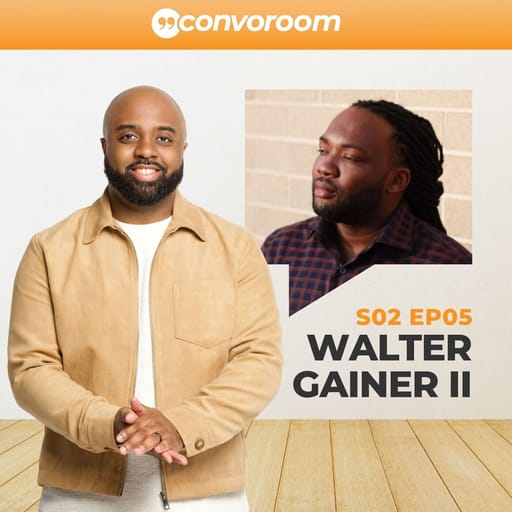
Transcript 0:01 All right, y'all. Walter is in the house this morning. He's in the Convo Room, and I'm so excited to have him with us. He is literally a selfless champion of others. 0:13 If you check out his LinkedIn, I mean, he's always hyping people up, putting you on to who's in his community. Uh, but today is all about him. 0:22 We're gonna unpack his story, his journey, how he's finding his way both as someone who's working in corporate and in the creator economy. And, uh, without further ado, Walter, welcome to the Convo Room podcast. 0:35 Hey, man, I appreciate it. I appreciate it. You know, we need people to, like, hype each other up. 0:39 We don't always give, uh, like, get our flowers and stuff, and I'm just very big on just, like, highlighting and showing love to people 'cause I've been benefited, like, I benefited from a lot of love from my community, so anytime I see someone who's, like, doing something really cool, I like to shout it out. 0:53 Uh, 'cause, you know, we a- uh, someone once told me I could find a million ways to f- like, a million reasons, like, why something won't work, but not as many, like, why something will, and I feel like a lot of people are like that, so I just like to show, you know, show love, let people know, like, "Man, y'all, you're killing it. 1:08 You're killing it." Yes. Just in case there's any self-doubt, so yeah. And I'm happy to be a part of this conversation, man. I like what you're doing. Thank you. 1:15 Uh, well, speaking of killing it, I mean, let's just unpack your resume. Just let's get it out the way, you know? 1:22 Uh, you've, I feel like, been at the intersection of creativity and corporate and figuring out how to create stuff out of nothing. 1:33 Uh, walk us through what you've been able to achieve in your career and how that's translated into your creator journey. Mm. 1:44 You're asking me this at the right time because I've, like, taken moments to truly sit and be like, "Oh, hold up. Okay. Okay, I've, I've done some cool things." 1:55 Um, so my first job out of college was at a startup tech company, um, where I was working customer support online chat, and it was, it, it was sucked. It's, it was annoying. 2:08 [laughs] I was managing, like, 10 chats at the same time, and these were, like, people who had these small businesses and using our software to help them sell across multiple platforms. 2:17 And, um, I like to start there because it's interesting as the creator economy's kinda turned into a place where you have to have a true sales process in order to truly, like, monetize, right? 2:29 And for the longest time, I was like, "I, I'm not a salesperson," and there's nothing in my resume that speaks to that. 2:35 But I've helped to build a lot of systems and stuff to, um, help people to monetize, whether they're small businesses selling their merch, their products, their digital products, whatever it is, across multiple ch- channels. 2:46 To then I, uh, moved from that company where I got to, like, experience project management stuff and, right? 2:52 I ended up going from, like, customer support to helping the development team build certain features for particular customers and, like, generated, like, a whole, um, additional stream of revenue for that startup too. 3:05 Um, and then I moved over to this, like, sports apparel brand where I started to get deeper into, like, the heart of what it's like to actually be in a small business. Mm-hmm. 3:13 And truly you need to grow something, so still e-commerce operations. And, um, at one point I almost became a CMO of this, uh, other, uh, product company. 3:25 They were selling, like, model trains for a lot of people who are hobbyists, right? 3:29 And so that's, like, a little taste of, like, a lot of creators start from, um, uh, creating about their hobbies, and I was beginning to start to work with a few people who were hobbyists. 3:39 But then I made a strong pivot from this whole e-commerce operations world to the p- um, podcast, 3:46 uh, production world and entertainment and media and creator economy by, um, getting a job as a podcast producer for a B2B, um, podcast production agency, and that was, like, a, that was a strong pivot moment. 4:01 'Cause before then, like, I was very interested in podcasting, becoming a creator. I was waiting for my invite to The Breakfast Club. Yo. So glad that didn't happen 'cause I would not have been ready. 4:11 Charlamagne would've asked one crazy question, would've been like, "Ahhh!" So, um, yeah, that didn't happen [laughs]. 4:17 But, uh, got a job as a podcast producer and got to see what it's like to use content to help to grow a business, so once again, kinda in this sales world without really realizing it, using content to do so. 4:29 And I was there for a few years and then got an opportunity to, um, go build a podcast network for a Black-owned broadcast media company, the Deserving One. And, um, just from scratch. 4:46 And that's, like, a moment where it's like, okay, like, there's all sorts of jobs in the creator economy, but this is one where I get to actually build something from, like, the not necessarily the ground up 'cause the company existed and they had some, you know, platforms and resources, but still something that did not exist before. 5:01 Like I couldn't- Yeah... go over to iHeart and do that. Can't go over to Revolt and do that. Can't go to, um, Amazon or anywhere else to do that, so I was like, "Okay, yeah, I'm, I'm, I'm taking this. I'm taking this." 5:10 So yeah, um, been able to build a, um, podcast network, which is, yeah, another, once again, just creating more opportunities for a company to generate revenue, but also a lot of creators to monetize. 5:22 Whether they were before or not, it's like being able to create this, this environment where they could just focus on their creativity, getting their podcast out, and we have a system in place to help with, like, selling and, um, you know, increasing revenue opportunities. 5:37 So, um, yeah. I could keep talking I guess [laughs], but that's, that's kinda, like, the highlight of everything. 5:45 Y- I'm curious, with you being able-- I think there's a consistent through line with being a builder there and, uh, being an innovator. 5:55 W- when you take on a role, especially, like, building out a podcast network or, you know, um, being a podcast producer and having to take-Elements that are, I mean, just ideas that just might be inspiration, but then actually be able to execute it, press record, get it distributed, promote it, all the above. 6:16 Like, how, how have you found your way in that? 6:19 Have you always been somebody that's been able to see projects through from concept to creation, or was it like a muscle that you had to work on and you kinda found your process in that? Well, 6:38 I think, like, to be able to do something well, you gotta fail along the way, gotta make mistakes, you gotta try, you gotta shoot for the moon. There's definitely been projects where 6:50 I was dealing with something where it was, like, someone who's a TV personality, and this other personality, they're like, you know, big-name people getting ready to launch something, and I didn't properly evaluate the situation. 7:03 Mm-hmm. I thought it was just, like, some, you know, um, just thing they were starting. But [chuckles] the night before recording, I found out, like, "Oh, y'all trying to get this on TV." 7:12 And just realizing while I did do what was asked of me, I didn't do what was needed, right? And that's where- Wow... 7:20 I learned to really be in the, kinda be the executive, even if you think, like, if you don't have all the answers, like, even though that's not your role or responsibility, still it's important for me to just know everything that's going on, right? 7:33 And I guess, like, if I were to pull that back to something, I don't know, maybe, like, playing soccer, actually, 'cause I used to play soccer back... 7:39 My dream was actually to be, you know, be on the US Men's National Team. Like, the World Cup that's- Mm-hmm... happening this year in Atlanta. Actually, I might have been too old by now. 7:47 But my plan was to be on that team that brought the World Cup home to, uh, the US. So I guess when you're on a soccer team, you know, you are one player, but you kinda have to meld and mesh with everybody. 7:58 You have to connect with someone who's on the opposite side of the field with you and just know how everyone plays and everything. 8:04 So I think it's just important when you're just going into a project, whether it's creative or anything- Mm-hmm... 8:08 to have a comprehensive understanding of everything that's going on, things that are not your job, things that are your job. 8:14 And if I had had that mindset, kinda been the executive, um, even if though that wasn't my role or responsibility, I would've been able to properly plan and prep those personalities so that they were successful, too. 8:25 'Cause when you don't get a project to the finish line, it's not just you who messes up, but you're kinda messing it up for everybody- Mm-hmm... um, even if that's not your responsibility, for real. 8:36 No, not always, but when it comes to being a builder, I love that word, too, that title. I like that. Um, I don't know. I was a Lego kid, so I just liked to build things and see how it works- Yeah... and everything, too. 8:49 So I like to know the, all the different pieces and all this, too. I like to think I'm, like, a Michael Schofield mindset, but I don't think, I think he's a little more advanced engineering than me, but... 8:59 You know, that's, uh, that's really interesting because I feel like even just seeing how you view your role as, like, uh, a piece of a larger pie, if you will. I think 9:13 people who are kind of, especially, like, I'm thinking about myself, you know, I'm a, kinda like a one-man show doing the thing, and I feel like there are- Yeah... 9:20 so many creators out here that are having to wear so many hats. 9:25 And how would you advise someone who has had to have somewhat of a systemized approach or, uh, someone who has had to learn to ask questions of those he's collaborating with? 9:42 Um, how would you advise somebody who is kind of at the beginning of their journey and thinking that, "Hey, I can, I can do all this on my own"? 9:53 What is it that they don't know about scaling and the systems involved to make something a success? 10:01 Can they really run it on their own, or is it, is there a point where it's like you're just gonna have to embrace the idea of getting a team? Oh, yeah. Um, I truly believe all things are possible. 10:14 You know, earlier you mentioned something about, like, you know, just being able to make something out of nothing. 10:18 I feel like, you know, that's just something in the Black community or any community or just if you've lived in, like, impoverished and just had to do that, you just kinda learn how to do some of those things. But, um, 10:31 I think where people mess up, and where I've messed up as well, is the expectations, right? Like earlier I mentioned, uh, waiting for my invite to The Breakfast Club. 10:44 That's something that happens once you've ha- already made a buzz and a name for yourself, right? And to do that requires a lot of different visibility. 10:53 And to have that visibility, you know, that could happen overnight, but usually happens over a consistent period of time of putting things out there. 11:01 I think, like, you know, we're on a podcast right now, so we take a look at some of the biggest podcasts or creators even. Actually, like, who's one of your, like, favorite, like, podcasters or creators? 11:12 One of my favorites, um, right now I'm loving Stephen Bartlett's, uh, Diary of a CEO. Mm. Um- That's a good example, actually, right there. Okay. Yeah. Right. So we know Stephen Bartlett, Diary of a CEO. 11:24 He's under a lot of fire right now. But, um, he's someone who puts out very long interviews, very highly produced, and has an exceptional, like, marketing strategy, right? 11:37 And so we look at him and we're like, 'cause I've done it, too. I've looked at him like, "Okay, I like how he put his, like, teasers out online. 11:43 I like how he has different social assets, one for the launch, one for, uh, the week where you're promoting the episode, one for, like, a few months back, doing a callback to a previous episode." 11:54 On his podcast feed, he has, um, a full episode, but also, like, callback, so he could be like, "Hey, this is one of our best episodes. Check it out." 12:02 I think that, um-We see all of what he's putting out there, but we don't see all the people that are behind it. So we have these expectations to do something like that, to build it on our own, and we can. 12:15 But I think our expectations put us in this trap that stops us from actually being able to do what we can successfully, right? Right. 12:23 So listing out all the different stuff he does to roll out his podcast episodes, it is a lot for one person to do, and he literally has one person whose job it is to create the teasers. 12:34 Like, they spend multiple days- Right... just working on the teaser. That's something I do, like, within a few hours, and that's a lot of work. But it's like he spends multiple days. 12:41 There's a lot of psychology and techniques in there. So, um, 12:46 what a lot of creators don't always think about is the amount of resources and personnel that it takes to hold up something as large as a Steven Barlett or even like a, a Kai Cenat. 12:59 Um, they just see the end result and be like, "I could do that." And you can, but it's just very challenging. 13:04 So for me, what I've learned is to have certain systems in place, but then also most importantly, is to know my capacity and also my limits. Mm-hmm. Like, I work full time. I'm working on growing a, a business as well. 13:19 Um, doing this podcast. Also have certain responsibilities that, you know, one, if you have a job, you're committed to that job. 13:25 You- [chuckles] and if you're not ready to, you know, be out on your own, make sure you keep that job. Um, and then two, the responsibilities of just, like, having a business. 13:33 Then also just, like, existing as a human being, it's important to feed ourselves and heal ourselves and everything too. So having, like, a realistic, um, 13:46 operations, like, way that you're working, um, just what- with whatever time you have and being okay with that, I think is the biggest part of it. 13:54 'Cause once we start to want to do more, it's like you can do more, you can push yourself, but if you don't know your limits, you don't know how far past your limits, uh, that you're going, right? 14:03 So if you know you can, like, if you could do an all-nighter, then cool, but can you do all-nighters like three days in a row? Like- Right... maybe you can, but just know you're kind of pushing past that limit. 14:15 If you keep doing that consistently, you're gonna snap your, uh, you know, capacity bands. 14:20 You're gonna burn out, and burning out multiple times in a row could lead to a lot of, like, health problems, a lot of mental problems, and just, like, feeling like a absolute failure. Mm-hmm. 14:31 'Cause sometimes we burn out for nothing, so. Yeah. I know I've found myself, um, like, just trying to diagnose why I would have so many starts and stops. And- Mm... 14:43 I found myself, um, because I'm like, you know, I, I do this for other people, you know? Yeah. I'm like, "Well, why can't I do this for myself?" Yeah. And 14:52 to your point, it's like you really have to assess how much time do you actually have? And also, just because you're good at something, it doesn't mean that you're gonna be passionate to do it for yourself. 15:08 Case in point, how many people do we know that work in social media and/or, uh, media and marketing, and they are able to do incredible work promoting projects, you know? 15:20 Um, I, I know some people that, um, they are, they work in the, uh, the music industry, and so they're, like, helping artists break or they're working for established artists and doing awesome campaigns. 15:33 Their social, personal social media presence is terrible. 15:37 And by terrible, uh, it, it's that you would not even be able to make the correlation between the amazing work that they do and the personal evidence of what they- Mm-hmm... do personally on social. 15:49 And I think perhaps maybe they have caught onto something is, in that they know they only have but so much time, and they're gonna cut work off. 16:00 But then there are the, the crazy ambitious, you know, creator-preneurs out here too that are like, "Okay, we're going, w- we're gonna shoot for the three all-nighters, and we're going, we're gonna do the sprint and then see if we can do something sustainable." 16:14 And I found myself doing this thing where I would be able to make great progress or great leaps, but not be consistent. 16:23 And so then I'm, like, figuring out, okay, there's gotta be something, and I've ha- surely have not figured it out fully. But I was like, "There's gotta be something that I can do 16:35 to be more sustainable in my output so I can see the outcomes that I'm looking for." 16:40 And so hearing you talk about that, I, I really think that one small tweak that I made, um, because I'm kind of at that spot thinking about like, "Okay, how do I start collaborating? How do I get with a team? 16:51 How do I, uh, just at least start outsourcing s- small pieces of the puzzle?" And I was like, "I have to make the workflow more efficient." There are too many, um, blockages to going from start to finish. 17:07 If you're gonna be a one-man show, a one-woman show, you've got to figure out a way to eliminate the friction in your workflow. 17:18 And so I'm, now, I was using so many, like, uh, so many tools, one for scheduling, one for recording, one for this. I'm uploading here, downloading here, you know, making a graphic here. 17:29 And so then I realized, I was like, "Oh, if I trim my tech stack, at minimum, I can save time." 17:39 And I think for so many people, maybe the first step is evaluating what you have capacity to do, and then looking at your tools to see, one, what can I do amazingly well, and then also what can I offload? 17:55 What can I-- Even if it's something as small as using, uh, like, uh, some, it... I promise I'm not gonna be a conversation narcissist and talk over my guest. No, I'm here with you. I'm here with you. But- Yeah... 18:09 like, um, I, I started, and I was talking to a- another guest in a previous episode about this. 18:13 Like, literally just even if it's, like, using your notes app to, like, startschedule i- scheduling and systematizing the way you do outreach. So then that way you're not guessing when you reach out to people. 18:26 That way it's like you almost have a, a systemized approach to making sure that you can at least s- get to the result you're trying to get to because you've got the output straight. 18:39 Now, you know, nothing's guaranteed, and I'm, I'm sure, you know, I'd love to dive into 18:46 how you've been able to go from when you're creating something out of nothing, and it's a great idea, and getting other people involved with it, like getting partners, people, uh, who want to invest in it, people who want to sponsor, or people who want to, uh, align their brand with a new concept or a new idea. 19:06 Like, what has been your secret sauce to finding some level of consistent success with that? Question. Before I answer, I wanna play with my camera real quick 'cause I feel like I look crazy. 19:22 That's another part about it. It's like being a one-man show. It's like when I'm doing this for other people, I could like adjust real time. Mm-hmm. Like I think that's much better. 19:37 Low-key, I'm over here, I'm like, uh, I'm like, if I could've just remembered to put on lotion [laughs] before. That's what took me so long to get ready. [laughs] I needed three minutes. 19:49 I was like, "Hold up, is that some ash showing up?" [laughs] I'm like, this winter trying to do me in. I'm like, okay. But at any rate, y'all, we in this together. All right. Yeah. So we talking about monetizing. 19:59 Walter, help us out. Mm-hmm. Yeah. Um, also in addition to that, right? 'Cause, uh, I've, I've realized there's one other part of your previous question I didn't answer, but it plays into this. 20:10 It's like some things we shoot for, but we're not ready for it yet. Um- Yeah... whether it's having a team, pushing for monetization, like all of that comes when everything's ready for it. 20:22 So sometimes people get a team too early, and the, the team could fall apart. You might not even-- You might be a terrible leader at the beginning 'cause you're still figuring certain things out. 20:33 Um, so- That's so good... yeah, but for the monetization part, um, there are a lot of different ways to monetize. There's ways to monetize from the very get-go. There's ways to monetize after you've built an audience. 20:46 So, uh, to take a step back, the most popular way of monetizing something like a serial, uh, 20:56 show is, uh, through advertisers or brand deals, and that's where a certain company, uh, brand, uh, whatever it is, wants to get their message out, wants to reach people, and they use content to do that, not their own content, but they will spend money to get their message out to people, right? 21:15 And as a business, you want to make sure you get the most out of your money. So oftentimes you will go to someone who either is the best person to deliver that message or the best, 21:27 uh, platform to reach a large number of people, right? 21:31 And so a lot of us, we start something and we go off like, "Oh, I want like a Coca-Cola or all these things," or, um, a lot of like, in podcasters, like Squarespace sponsors a lot of business ones. 21:43 You see, hear a lot of Prize pick, uh, ads- Yeah... for a lot of entertainment brand. Um, some alarm company might sponsor a podcast 'cause they interrupt, uh, [chuckles] interviews. But, um, 21:56 uh, these companies come 'cause they wanna reach a certain audience, and so they're gonna, you know... That's-- Some things are just, uh, unattainable. 22:05 But even with that being said, there are brands who will reach out to you because you are the right person to deliver that message, and you're using content in a way that can speak to their people, and that could happen at regards to what size you're in. 22:17 So back to like expectations, you kinda have to know what it is you're building and why you're building and who it's for to attract the right people. 22:25 Um, that's where like companies like where I work at, we deal with a lot of large enterprise, uh, clients who wanna advertise and reach a large number of people. 22:34 So we're able to have those relationships and bring them to creators. But for a lot of independents, they'll either, um, build those relationships themselves through just like meeting people. 22:45 Th-they could also, you know, create relationships with local small businesses in your area to, you know, work out some type of deal, whether it's like, you know, whatever money you spend on the podcast, it'll go in the ad, but maybe also I'll do some stuff on social media for you. 23:00 Um, so there's all those like different ways to advertise. 23:02 But another way that people don't always talk about, and I think this is one that's becoming a lot more popular now, is monetizing your own stuff by creating services or digital products, or even building a community that you can sell directly to your, um, audience. 23:19 And I think that's really, really special because something I learned from, uh, Roberto Blake, who's this big, uh- Yeah... 23:24 YouTuber, he's a Black YouTuber who helps a lot of other YouTubers get their YouTube stuff together. 23:30 Um, he shared just like how when you do create your own digital product and you sell it, even if it's for like a small amount, a dollar, and you get enough sales, that's data that you could then take to an advertiser and be like, "Hey, hey, hey, I know I might not have like a million downloads or a million followers, but I do have proof that I can sell, um, directly to my audience if it's something that they actually want and will be good for them, and here are the numbers to show like what I've been able to do." 23:58 And numbers are really what tell the story. Like people focus on downloads a lot, but there's so many numbers to use to tell your story on why you'd be a great partner to work with. 24:07 So, and then also when you kinda create your own ways to monetize, you really do own the whole process, and then you get to be a lot more selective about who you work for. Um-Yeah. I'll, I'll stop there for you. 24:22 Well, actually, I want you to double-click on that. [laughing] We talked about this before we started hitting record, like, the-- my, my phrase, if I want you to go deeper on something, it's to double-click. Mm-hmm. 24:33 Well, um, I think this is really important, and I'm gonna tell a little bit of a story, but we're coming back to the whole point of, like, knowing your numbers and the numbers that explain to a partner that you are the ideal partnership or you, you're somebody who makes sense for them to join hands with and, you know, do this work. 24:55 Um, something that I learned in communications very early on, 'cause I, uh, work in nonprofit right now too, 25:03 and, um, it's so d- [clears throat] excuse me, it's so difficult to get people who are doing amazing work on the ground- Mm-hmm... to pause long enough to do their metrics. 25:17 And it's, it's almost counterintuitive because in, uh, the department that I sit in, we're at the, uh, we're at the intersection of the programs and the work that people are doing, and the communications that go out to help fund the work. 25:38 So in order to fund the work, we're always mining for stories. 25:44 We're always getting highlights from events that have happened and, and things that are going on within the organization, and we're packaging those talking points and/or stories and/or metrics and saying, "Hey, if you would like to make this kind of impact, partner with us. 26:04 These people are doing this kind of work every day." Mm-hmm. Well, I think the same is true for creators, but perhaps I think there might be a disconnect in understanding what numbers really matter to the brand side. 26:18 Because, um, vanity metrics, I think, you know, e-everybody might have this idea of, "Okay, well, I can reach X amount of followers, and maybe I can see this kind of traction." But I think maybe you can help be a little 26:35 sobering to creators- Oh. [laughs]... who are [laughs] looking to, uh, monetize their work, but they're like, "I don't know how to position myself. 26:45 I don't know what numbers to package and sell as my story as to why a brand should partner with me." Like, what numbers are you talking about when you say, like, these are the numbers that tell that story? Gotcha. 27:03 Man, to be sobering as well, 'cause sometimes you hear certain numbers and you're like, "Oh, I ain't, I ain't, I ain't close to that at all." 27:14 There's-- I, I mentioned The Breakfast Club earlier, so I used Charlamagne as an example. He has a podcast. 27:19 I remember once they mentioned how they get, like, maybe one to two million downloads on their podcast a month- Mm-hmm... in totality, and that's like... And they have very big name brands that work with them. 27:31 Um, so the numbers, the metrics everyone could follow for podcasters, the main metric that everyone bases, um, the size of your podcast and the value of it on is downloads. For YouTubers, it's mostly views. 27:49 For content creators on social media, it's like a mix of followers, but also views and reach. One thing that's a universal metric for everyone is impressions. 27:59 So, like, views and downloads are kind of similar in a sense, and you could do, like, a deep dive into, like, the true differences and the science and everything. 28:07 But, um, essentially it's like how many people are watching or listening or viewing what you're putting out. 28:13 Um, impressions are a little bit different, where it's really just, like, um, how your content shows up, like how m-many places it does. 28:21 Is it, like, are people seeing it on the homepage, the explore page, a browsing thing, a suggested search, all this stuff. There's different impressions there. Um, those are, like, oftentimes 28:34 the first numbers that people look at. The following, of course, as well. 28:37 Another thing that's really important to how successful that ad is, uh, if you do the advertiser route, is, um, when you get into, like, more, like, the watch time and the completion time and, like, how far in your audience gets to the episode, right? 28:54 'Cause usually when someone's advertising, there's an ad at the very beginning- Mm-hmm... um, which a lot of people see, but where a lot of the money is made is in the episodes. 29:04 For a lot of long form content creators, whether you're, you know, YouTube or podcast, it's those ads in the middle of the episode, and you can have an ad in there, and you might have, like, a ton of views, but if people are not making it past that 10-minute mark, they may never hear the other ad, which means they'll never even hear about the offer, even if it's a perfect offer for them. 29:25 Mm-hmm. So it's also important to know when you're communicating to these brands, um, for podcaster, it's the, um, listening consumption time. You can see that in Apple Podcast. You can see it in Spotify. 29:37 For YouTubers, I would focus on that watch time and see where people are kinda dropping off. 29:43 Um, I don't know if brands always pay attention as much to that, but it's important for you to know just so you know how successful, um, you can be and also how to get people to continue to move on, like, all the way through. 29:55 'Cause really, as a creator, you want people to watch the-- completely get to the end of what you're doing. Not everyone will, but that's your goal. And people who do get to the end, that's your core audience. Um, 30:08 but then there's a lot of other numbers that you could do too, right? Um, there's a woman named Nya Peoples who's really, uh, good at, um, um, helping people to create a whole ecosystem around your brand, right? 30:21 Because that's just, like, the core number, right? But if you have, like, a, uh, websiteAnd you promote your website with a podcast or your YouTube or whatever. 30:31 You could track link clicks from your podcast, YouTube, whatever, out to your website and track that. You have your website analytics because maybe, 30:40 maybe like you have really great SEO and you get a huge amount of traffic on your website too. 30:46 Um, I always know if a episode I did is successful or not because sometimes I'll get like an analytics notification about like, "Oh, this episode you did, this like page has been getting a lot of traffic recently." 30:58 And that lets me know that a guest I have is out here doing their thing. Mm. And I always, I'll always hit them up and be like, "Hey, by the way, your episode's doing, doing some good numbers. 31:06 This website's getting some traffic. I haven't promoted it, so I know you doing your thing. People are finding it 'cause you out here doing it." And that's like just a way for me to show love. 31:14 But yeah, there's a lot of numbers out there that tell a story on social media. Um, I mentioned views of course, but there's saves, there's comments, and the, and the comments is a really good goldmine. 31:25 That'll be a metric- Mm... that'll exist forever. Um, comments, saves, and sends. Sends tells you that this piece of content was so good or did something that made someone want to share it with somebody. 31:38 Saves is like a, um, whether they actually do or not, it's like an intention to go back to this for later. Mm. 31:45 Um, and then comments is like something triggered you to be a part of this conversation too, and those are always important for brands to know of as well. So there's lots of different numbers. 31:55 Um, we could double-click further, but that's, that's a... A lot of numbers that tell a story. I mean, listen, w- we got some time. Like, educate the people. 32:05 Um, I, I feel like the metrics thing is, um, you know, for somebody who is like me where you can kind of almost like go down the rabbit hole, it's almost a little dangerous because then like you're like, "Oh, let me build out a dashboard. 32:19 Let me like do all this stuff and overcomplicate it." Yeah. So perhaps for the creators who are out here trying to be efficient with their time, make the most impact, and they're doing it 32:36 w- either with a lean team or they're doing it on their own, what are the most important things they should be tracking? 32:43 Like the, the top things they should be tracking and in a rinse and repeat cycle, making sure that they are feeding-- What actions feed those kinds of metrics? If that is a clear question. Mm. Yeah. Um, 33:01 there's another actually metric too, and that's how the kind of the quantity, right, that you put out in a period of time. 33:09 'Cause another thing advertisers, not just advertisers actually, so I think like, you know, we obsess a lot over advertisers and brands to be a part of our stuff, but really what really makes you a successful creator is the people that tune in to your stuff, right? 33:25 So let's kind of ignore advertisers for a second, 'cause advertisers really want the people. 33:29 We always like-- I, I lose myself trying to follow the advertiser and monetizer, but it's really all about like who decides to spend their time listening to what you're putting out or watching what you're putting out. 33:40 So, um, back to views and downloads and stuff like that, those are probably the best numbers to track. But I personally would highly encourage everybody who's creating to find a way to build some sort of community. 33:57 And that's a trap as well because there's a lot of like software that exists to build communities, create communities like School, uh, Patreon, um, 34:08 uh, there's, uh, I mean, there's, there's a whole bunch of them out there. I think like Mighty Networks, I think is out there. Mighty Networks, yeah. Group app, Circle. Yeah. 34:17 Um, those are big existing like the business thought leadership space. Um, Patreon exists in the creator space. Uh, but there's, there's a ton, and all of them are great. 34:26 Um, but being able to build, like create something and curate that community is really, really special and will be incredibly valuable as you continue to grow. 34:39 Like a lot of people who get canceled but don't really get canceled, they don't really get canceled because they have a very, very core community that's like not ready to let them go. Um- Yeah... 34:47 so they stay, they remain, um, where they are, and they're able to sell directly to them, so they don't need, um, advertisers or brands in order to be successful. 34:58 So but there's a, there's a lot of free, uh, ways to build a community as well, and like YouTube is building out their community. There's still Facebook groups that still works. 35:07 Um, Threads is kind of like, it's not really your own community, but there's a way to kind of build within there. Mm-hmm. Um, email is probably the best way to kind of build something because you have- Yes... 35:20 an email list and you don't need any platform. You can go everywhere. Um, Substack is growing and that's a kind of like a community type of platform too. 35:29 Um, so I think commu- if I was a cr- well, not if, [chuckles] I am a creator. [laughs] Uh, yes. Let me s- [laughs] Um, as a creator right now, what I'm focusing on, like I'm not super focused on monetization. 35:42 I'm super focused on putting out content consistently so that I can build a community alongside of it, because you wanna be a part of people's like daily or weekly habits and rituals, something they check out when they're getting ready for work, when they're going to bed, well, when they should be going to bed, but they're doom scrolling, um, in between work and all that stuff. 36:03 It's very important for you to put out content consistently. So like you mentioned before, you might have to like, you might not be able to do the super produced thing, but maybe like a smaller version of that. 36:13 Um, but it's just putting out good content consistently, whether it's weekly, bi-weekly, monthly, just making sure you show up when people expect you to show up, and find ways to talk directly to, um, your people. 36:26 That's hard sometimes 'cause sometimes it takes a minute for people to be like, "Okay, yeah, let me like send a message out," or... comment here or there, but there's more ways to do that now than there were previously. 36:40 So I'm gonna affirm everything you just said, and almost even just double down on the newsletter piece, because hands down, the most effective tool in terms of an owned media channel that I've seen thus far is my newsletter. 37:00 M- metrics can be trash across every other platform, but that newsletter, the audience in terms of, I, I've been doing it for, like, a little over 100 weeks, and that audience is, when I tell you, stable. Mm-hmm. 37:17 Stable, stable. Like, they are bought in to your message. And I think there's something different about people who can passively, um, just consume your content on social, 37:29 but there's something about somebody saying, "Hey, I'm gonna give you my email because I'm interested in what you're saying." 37:36 And also something that I found is, like, even just, like, building connections and relationships on social media, LinkedIn in particular, um, I found that people, like, even the past couple days, uh, I was just, uh, I got a DM yesterday. 37:50 Someone was like, "Oh, hey, I just subscribed to your newsletter. Like, love what you're talking about." Didn't even ask, but because, uh, and I've got this discipline from, uh, who did I get this from? 38:02 Oh my gosh, I forgot. If I remember, I'll, I promise I'll post about it to give them credit. Um, but they were talking about just simplifying even your link in bio. Like, the only link you need- Oh, yeah... 38:15 is your newsletter. Like, do not give people a bunch of choices because your only goal is to, it's, as you're talking about, create that community. 38:25 And from there, to your point, like, you can weather pretty much any storm because you're always interacting with and talking with people who are bought into your message, and really I feel like they're just bought into you personally because they know you, they like you, they trust you. 38:44 And, um, yeah, I, I just think that you're spot on, um, with that. And- Mm-hmm... I think something that is by far the most rewarding is when I get a reply, uh, from somebody- Yep. Yep... 38:57 directly, and they're like, even if it's sometimes just a two-word, I'm like, they're like, "So good," you know? And I'm like, "Oh, great." 39:05 Like, this, this thing that I, you know, took the time to, you know, make sure that I continued the conversation on, it resonated. Or some people will go as far as to, 39:14 I mean, like, just lay it all out there, like, ex- explain, like, "This is where I am, and this is how the message helped me, and this is what I'm doing." 39:22 And, like, I have been floored at the audience that I've been able to, and I don't even say audience, like, it feels like just kinda cold and distant and out there. It does. I'm trying to figure out that word. 39:34 Like, I don't like followers, I don't like audience. Yeah. I'm like, "Bro, what?" 39:38 The- It almost, it, it, it's, it's really weird because I don't wanna throw around the word friend, 'cause I feel like, you know, that's an earned thing. 39:46 But if there's a, you know, if, if there are levels to this or circles of friends, if you will, like, um, that are in the, uh, in the sort of like, "Hey, we kinda know each other," um, 40:00 I've just been so surprised to see how much value I've been able to exchange with people, and I'm, like, literally impressed by what they're doing. 40:13 And, and they're just taking morsels of what I'm saying just based on my insights, and they're, like, taking it to, into what they're doing, and I'm like, "Man, like, are you kidding me?" 40:22 Like, I'm, I'm, I'm following you, you know? Yeah. And so it's- it's just so great, uh, to, to cultivate that community. And yes, I know we're talking about it in the context of monetizing, 40:35 but I just think that it's, it's probably the most rewarding thing as a creator because you can create and feel like you're on an island by yourself a lot, and even doing the newsletter because it's, you know, it's, unless you're on social media, it's not growing. 40:51 Um, or unless you're in front of people, you know, you've gotta promote it, you've gotta get out there. 40:55 But, um, by far the most relationship-rich channel that I have, and, um, I'm looking forward to figuring out ways to authentically monetize it and not, um, get in the way of the relationship building that's happening there. 41:12 Well, just to, I just wanna just share how, like, I, I absolutely love that analogy, and even if friends isn't the right word, 'cause I, I agree with you, 41:22 if we have that mindset, then we, we, we, um, we treat our friends well, right, with a lot of respect. Yeah. Respect we don't always treat our family members with too, right? So family's kinda like a weird word too. 41:33 But when we keep friends in mind, then it's like when it is time to monetize, it's like, hold on. Like, me personally, I don't like to make money off of my friends, um- Right... 41:43 yeah, it's just like I wanna, i- if I'm providing a service, I'll, I'll give it to you, but I also wanna make sure you're good, you're straight. I'll go above and beyond. I might discount it. When we have that in mind, 41:53 um, you know, [laughs] a lot of people in my circle are like, "Nah, well, raise your prices. Oh, it changes everything and stuff." 41:59 But it's like, yo, if I'm, if I'm building something, people are choosing to listen and spend time with me, I wanna make sure they're getting exactly what they came for. 42:07 And I wanna make sure, like, my whole thing, especially with my show, um, Working While Black show was all around, like, um, sharing the information that may not be as accessible unless you've kinda been through it and lived it, right? 42:20 Mm-hmm. So it's like, how am I supposed to, like, like, it feels so wrong to charge for some things sometimes. We like to do a lot of things for free. But, um, I, I just like that French, uh, like, friend analogy, right? 42:32 'Cause I think it's a lot more appropriate sometimes too. And for what you're doing right now, you are creating this medium thatEnds up developing this, like, intimate relationship, right? 42:42 'Cause people are spending their time, like, whether they got headphones on, they're listening to your words and- Right... 42:47 like, there's just a trust that, that is there, uh, with-- And it just kinda creates this responsibility to not just say anything, not just, like, promote anything- Exactly... 42:57 but to truly give something that, that can continue to earn that trust, right? Like, there was a brand that reached out to me off of a post. 43:04 They saw a post I made, and they loved it, and I was like, "Oh, that's what's up," 'cause it wasn't a post that super performed well, right? 43:11 But they loved it, and they're like, "Oh, we'd like to, you know, work with you." And I was like, "Okay, cool. They love my shit. They wanna pay me some money. Yeah, let's get it." 43:18 But then I was, like, thinking about it, I was like, I personally wouldn't use this. There's probably somebody who could use this, but I couldn't use it, so what am I gonna talk about? 43:27 Like, if you're this person, you can use this for that. 43:30 Yeah, I could do that, but I'm really moving into a space where it's like I really wanna truly talk about or promote things or offer things that I personally use, um, or it could be just something I know a lot about and people would use. 43:43 But I personally wanna do the stuff that I use. And also another way to kinda help to curate those relationships, 'cause a lot of these relationships start on social media. 43:56 There's a lot of things people are seeing now where it's like, comment this word to get this. Yeah. That's kinda replacing a whole go to my link in bio. 44:03 I think the link in bio's still important, but people aren't going to profiles anymore. Uh-huh. So you have to find a way to make it as easy as possible so that no one has to do any extra work- Exactly... is to get that. 44:14 So there's lots of tools out there. ManyChat's the most popular one. 44:17 They have a really decent free plan where if, you know, you just say comment book, and I'll send, uh, send you this digital e-book on how to do X, Y, and Z. 44:28 Um, and then when you do that, you're able to, you know, collect that email, um, if they choose to share it with you, and then they could be a part of that email newsletter. And, um, last thing I'll say is, um, 44:39 my favorite tools right now for email are Beehiiv and Substack. They're two completely different tools. Substack's more of like a social- Uh-huh... 44:49 community that you also get email as well, and Beehiiv is strictly email, but you could create your own website and everything too. But those are, like, the two that I always tell people about right now. Now, 45:01 Beehiiv has not paid me a dime for what I'm about to say. Um- Come on, Beehiiv, act right. Let me tell you, let me tell you something about Beehiiv. I'm gonna ride for Beehiiv 10 toes down. 45:13 Let me, let me tell you what happened one day. I-- So you, uh, I was just trying to, you know, as a creative, you know, you always just changing stuff. 45:22 And so I accidentally, like, instead of deleting, uh, a, a, a, what is it, a publication within my slate of newsletters, instead of deleting one that I wasn't using anymore, I deleted the whole 45:41 account. Mm. And when I tell you, I was freaking out. And, you know, I was thinking, like, I, I was just moving fast, multitasking. But the level of customer service that they extended, 45:57 when I tell you, it was like, number one, I feel like when you're using some of these, um, software as a service companies, it is so impersonal. 46:08 If something happens, y- y- I mean, you ain't about to get nobody on the phone. 46:12 But the level of intentionality and response and care that I received as somebody who was going through a situation where, I mean, you know, my newsletter is nowhere near some of the massive newsletters I know that they're dealing with. 46:27 And, um, like, they, they came to the rescue. And so I just say for anybody, and not just that, I've been kinda, like, looking into h- how Beehiiv handles, um, their split of profits per se versus Substack. 46:45 Um, and, you know, you guys just look into it 'cause obviously everybody should do their own research. But, like, it's just night and day compared to... 46:54 I think what they've done is they've cornered the market now on understanding the future of the creator and content economy and what creators actually need versus putting out a product that... 47:10 And I think it's, I, I say Substack is super popular, not trashing Substack at all. Um, but I think it's the psychology of, like, the type of creator that you are that it makes sense for... 47:22 And I think my audience in particular, like, if you are a one-person show, like, with the full integration of things that they have going on, like, this is one place to be, and the customer service is, again, like, top tier. 47:36 I, um, so I'm not a, I, I was gonna use Beehiiv, but I chose not to. Um, but even me choosing not to, I still recommend it 'cause all the things that you said. 47:48 There's this, uh, story that someone shared with me recently about something that happened similarly with them where they deleted their whole thing, but it was Substack, and they didn't get that type of service. 47:59 [chuckles] They lost all their shit. Um- I'm just saying. Yeah. And I just, I've heard actually from several people that love Beehiiv, love Beehiiv's team. Their whole staff is very accessible. 48:13 And I, I actually, yeah, I, I fully agree with you. And, like, the reason I chose Substack is not anything s- necessarily special about Substack for real. It's just like, see what they're building now. 48:28 Before it was like, "Ah, it's hard to choose," but now it's like, oh, these are completely different things. 48:32 Like, like you said, Substack, I, Substack is literally a, an additionary, additional social media platform that has email in it as well, and I'm using it more for theSocial aspect of it than the email part. 48:47 I think at some point I will make my way back to Beehiiv, but as of right now, it's like you, you kinda have to choose all between all the different software that you have, and it's like- Mm-hmm... 48:57 as I'm going down this list, actually I realized that what I truly needed even more than a email newsletter was a true CRM platform, and that put me in a whole rabbit hole of looking at HubSpot, looking at GoHighLevel. 49:10 I'm using Stand Store right now, which Stand's like an interesting company too, and they're doing- Mm-hmm... this whole, uh... Have you seen their Dare to Post challenge? 49:19 I have, I've seen content about it, and I, this is honestly just me. I feel like I have to, like, put blinders on, 'cause I am, like, shiny object syndrome central. I will jump on [coughs] every challenge and everything. 49:34 Uh, I love what Stand, um, because they're, actually their founders, when we talked about Stephen Bartlett, that's how I found out about them, like, through- Same... Diary of a CEO, of all their content. 49:46 And I was, like, all in it. So, like, I see all the ads. But w- uh, you bring it up because? 49:52 Oh, um, and I will say, as far as shiny inject- object syndrome goes, if you're on Beehiiv, I would not leave Beehiiv for Stand. As of today, Beehiiv's... They got it. Stand will get it, and they have some good products. 50:06 For what you're doing, Beehiiv is perfect. Um, I forgot why I brought up Stand, actually. Oh, yeah, yeah. 50:13 So, um, [chuckles] I was just, like, evaluating all the different software I have, and it's like, okay, in this era right now, like, like, last year I planned to go really hard with live streaming this year. Mm-hmm. 50:22 And I was gonna get Ecamm Live, 'cause I think it's the best, uh, streaming software if you're streaming from your computer. 50:31 Um, but I was like, "Okay, I have all this different software," and it's like at a certain point, like, this subscription's accessible, that subscription's accessible when you- but when you have, like, 30 different subscriptions, it's like, what, what? 50:43 Nah. So I have to, like, cut back and choose what I'm putting my energy into this year. So it's like I'ma have to circle back around to, like, the Beehiivs, the Ecamm's. 50:54 And it's not for the price point, but just more so, like, to do that means I'm at, I have to do this certain thing with the content. 51:00 I need to build an engine with the, uh, email the way I wanna do it, build an engine with the live streaming to do it the way I wanna do it. And it's like being okay with not doing everything- Oh, yeah... 51:12 all at once, 'cause that's how you fall apart sometimes. Unless you got a team, so yeah. Uh, have you heard of Riverside before? Oh, yeah, yeah. Yeah. Oh. Riverside's a really good platform. I'm on Descript now. 51:25 I moved from Riverside to Descript. But once again, for particular purposes. Mm-hmm. But yeah, nah, Riverside's a beast. What was the, uh, difference between the two for you? 'Cause I was wondering- Um... 51:37 when you said, like, the streaming thing and trying to do things, like, all in one platform, like, what brought you to Descript? Good question. So it was a couple things, right? 51:46 'Cause it's like every software right now is looking to be a all-in-one software, uh, the one solution for all your needs. 51:54 Um, Riverside's competing with Descript, they're competing with the StreamYard's, the Ecamm Live to an extent. 52:02 Um, and I, at the time, my, the plan I was on wasn't the plan for the live streaming, so I was about to get it, but then I was like, "Well, I like Riverside for podcasting. 52:14 I do have another solution I can use for live streaming. It's not the same- Mm... as Riverside, but it, it's good enough." 52:20 And what I really needed was a tool that'll allow me to record what I'm doing, which Riverside can do, then also edit. 52:29 And most of what I do editing-wise is Adobe Premiere, but when I was looking at Riverside and I was looking at Descript, I think Descript has a much stronger, uh, editing platform than Riverside does. 52:40 Riverside's is nice, but Descript has been an editing platform for years, and Riverside is getting into it now. So I needed something that could do a lot right then and there, and actually really glad 52:54 I went with Descript f- uh, for that. But Adobe Premiere is still the place where I do a bulk of my editing for, like, the sharp scalpel cut- cuts. 53:01 But if it's just, like, oh, you just need a little stitch here and there- Yeah... I use Descript for that. That's nice. Um, I love that we've just got, like, literally, uh, did the deep dive into the tech stack. 53:13 Uh, so- It's true. We could go deeper. Um- It's like [laughs] there's so much. But yeah, I'm not tr- We could, that's why I said we could be here for hours, man. Yes. Uh, so let's, let's land the plane here. 53:26 We started talking about, um, earlier in the conversation about how you posted earlier today, and I'm not trying to get you to bare your soul or anything, but, like, where do you see yourself going? Like, what is your... 53:41 If you could just look in the future, and if everything all works out, like, where are you headed? What are you doing? What are you building? You know, um, 54:01 in a sense, I'll bare my soul a little bit. Um, I think it's important to do things that'll make your younger self proud. Um, when I was little, like, I didn't grow up, I was a PBS kid, right? 54:14 We didn't have cable, um, and I was, we didn't have internet for the longest, so I missed out on a lot of stuff, the AOL and all that stuff. But, um, 54:23 uh, like, my grandma, she had cable so, or no, she had DirecTV, uh, for a moment and everything. And so when I would got to go to her house, I got to watch everything. I was like, "Yeah, finally." 54:33 And I remember, like, you know, you have trouble going to sleep. 54:37 You know, you do all these things, like people say count sheep or whatever, and I r- remember, like, I just thought it was always interesting, like, looking at the channel guide and seeing, like-Well, there's Cartoo- Cartoon Network, Boomerang, um, Adult Swim, Toonami. 54:51 I mean, Adult Swim, Toonami are separate channels, but I was like-- I was spending my nights, like, counting all the different stuff that Car- was a part of the Cartoon Network universe, Nickelodeon universe, the Disney universe, and I'd just be, like, counting, like, these networks. 55:03 And so I think for the longest time, I really just loved the concept of having, like, a network, like of the whole media stuff and, like, what, what's a part of what, and what's here and all that stuff. So 55:14 long term, what I'm building, what I'm really excited about is, um, creating a company that produces IP, right? 55:22 Um, so for those who don't know, the intellectual property, and that's becoming a bit more of a common word now because people are realizing the importance of truly, um, creating something that you own, right? 55:35 Like we see, um, uh, with Ryan Coogler's deal with Centers, like he's-- owns it and gets, like, the rights to the music and everything back in a few years. 55:44 And so there's so much you could do with that, um, IP that he owns, all these different spin-off universes and stories you could tell all connecting to this one central concept, and that's really what I'm building right now, is this company that tells stories, that creates content and scales it out into different, uh, universes of stuff. 56:05 So it's like being able to take a comic book and turn it into a whole, uh, movie and theme park franchise and all that stuff. That's the stuff that excites me right now. Like what, what stories can we tell? Mm-hmm. 56:17 And then from those stories, what all can we do with it, right? 56:20 Um, and right now I'm focused on stories that are from our culture, from people who are doing things really impactful right now, things that people have done things in the past, and just right now just focusing on like the actual telling of stories part that can, um... 56:34 Uh, it's kind of what, what, uh, Kendrick say, you know, "I make music that electrifies." It's like that's really what I'm looking for right now 'cause I think it's, um... 56:41 Like right now in particular, sometimes it feels like there's no hope and it's all doom and glory. 56:47 And regardless of how true that is, I think there's a lot of people who are doing some impactful things and bringing about the change to help to heal us, help to, uh, grow us, and I'm working on telling stories of people who went from, like, surviving to thriving in the workplace. 57:03 Yes. Um, and all that stuff is stuff that make my younger self proud, especially, like, not even, like, millions of years ago. 57:08 I'm, I'm not that old, but, [chuckles] um, just even, like, graduating out of college, I was really struggling with, 57:15 um, not only entering the workforce but also doing so as a Black person with locks and knowing that I'm entering in these, like, all-white spaces and there's already judgment in general, but people look down on Black people. 57:26 So I wanted to create something that where people know that we're enough and we're amazing and do amazing things. 57:33 There is a whole community of people for us and people going through these same things too because I think, um, speaking to the post as well, I think when we're kind of isolated, ooh, it's easier to go insane, right? 57:48 Or just be very depressed. But when you're in a community with people who find similarities that m- you thought made you weird but really it's like, "Oh, no, this, this is how we are," and stuff like that. Mm-hmm. 58:00 So that's, um, where I see myself is doing that, um, long term. Short term, it's more like the balance of being an executive and also being a creator at the same time. Yeah. Mm-hmm. Yeah. I, I, I love that. 58:17 And how can people follow along? Where can they find the latest and greatest content? You know, I f- I follow you on LinkedIn, but, you know, where- Hey, yeah... to consume all the things. 58:29 LinkedIn is definitely the place, Walter Gainer II. Um, I'm really invested in YouTube this year. I have-- creating two channels. 58:38 One is Boss Locks Media, one is, uh, uh, more of a personal media building channel, it's Walter Gainer II. Um, Substack, I'm venturing into that territory. Still over in IG 'cause I'm liking what Meta's doing. 58:52 Threads is like, I don't talk about nothing productive over there. I'm just, I'm just in the replies, man, sending gifs and memes- Yeah... and all this stuff. But I love Threads, so I just have fun- Me too... 59:01 over on Threads. I figured, I, like, I never figured out Twitter. I always loved Twitter. I loved consuming, but, uh, Threads just feels natural to me. Mm-hmm. Um, 59:11 and yeah, honestly, wherever, wherever you see Martin Patterson, I'm there too, man. Uh- Hey... and if you follow me, let me know you came from this podcast. I like what you're doing. 59:19 I'm new to this, but I like what you're building and everything. I like the conversations you're having. I was listening to the one with the guy from Philly. 59:25 Uh, if you're listening to this episode for the first time because you saw me somewhere, just please check out his show and everything. 59:30 If you made it this far, I mean, that means you enjoyed it and it's not just 'cause of me. But yeah, also if you're coming from this show, definitely, definitely hit me up, DM me. 59:38 Like we talked about, I don't-- just, like, if you follow me, that's cool, but I wanna know, you know, people who are in my universe and ecosystem. So say what's up, say you came for the podcast, and we can kick it. So. 59:50 Yeah. Well, thank you so much for stopping through the combo room today. I really appreciate your time, Walter. You have a great rest of your day. And thank you all for joining me. See y'all in the next one.